


Title
Subtitle
Lorem ipsum
Title
Subtitle
Lorem ipsum
Informations sur l'emballage
PET durable et entièrement recyclable
Le PET peut être très bien recyclé. Si l'on considère les différents emballages dans lesquels les aliments peuvent être emballés, le PET présente la deuxième plus petite empreinte écologique (juste après le verre consigné, mais bien avant le verre non consigné ou les emballages en aluminium). Pour une boutique en ligne, cependant, le verre consigné est une taxe environnementale car le verre est plus lourd que le PET, et l'expédition et la collecte créent une empreinte carbone plus élevée.
Ce produit est présenté dans un pot PET robuste que vous pourriez utiliser comme rangement pour des jouets, des vis ou d'autres choses..... Partagez avec nous comment vous les utilisez !
Title
Subtitle
Lorem ipsum
Informations sur l'emballage
Produit en vrac dans un sac
Pour réduire notre empreinte, nous proposons nos produits en grandes quantités, afin de minimiser les déchets d'emballage.Ce produit est livré dans un grand sac.
Informations sur l'emballage
Produit en vrac dans un sac
Pour réduire notre empreinte, nous proposons nos produits en grandes quantités, afin de minimiser les déchets d'emballage.Ce produit est livré dans un grand sac.
Informations sur l'emballage
Produit en vrac dans un sac
Pour réduire notre empreinte, nous proposons nos produits en grandes quantités, afin de minimiser les déchets d'emballage.Ce produit est livré dans un grand sac.
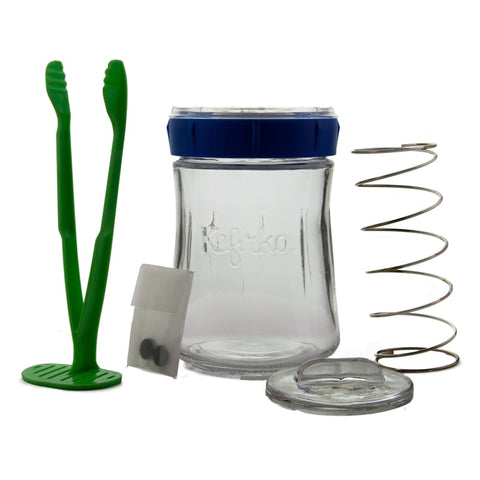


Vegetable fermentation jar
-
 900 ml glass jar
-
Perfect for fermenting vegetables and fruit
-
Easy to use
-
Great for beginners and pros alike

Fermented vegetables are extra good for you
Fermented vegetables come with a whole list of health benefits. Thanks to the natural probiotics they contain, they help keep your gut microbiome in balance. That’s good news for your digestion, your immune system, and even your overall nutrient absorption.
The ideal jar for fermenting vegetables and fruit
Fermenting is a time-honoured way to preserve produce—and with this handy jar in your kitchen, it couldn’t be easier.
It comes with a tamper and weight to press down your veggies, plus a clever lid that lets you release leftover air and seal the jar tightly.
Ready to make your own kimchi, sauerkraut or cherry tomato bombs? This jar has you covered.
DIY fermented cabbage: step-by-step
-
Sterilize your glass jar.
-
Slice the cabbage into thin strips.
-
Add 20 g of salt for every kilo of cabbage—measure carefully, this ratio matters.
-
Massage the cabbage with your hands until it starts releasing lots of juice.
-
Pack the cabbage into the jar, along with as much of the liquid as possible.
-
Use the tamper to press the cabbage down firmly.
-
Place the glass weight on top and press until the liquid fully covers the cabbage.
-
Close the jar tightly and pump out any remaining air by pressing the soft spot in the middle of the lid.
-
Let it ferment at room temperature for up to three weeks.
Tips for successful fermentation
-
After a day or two, you’ll notice bubbling—this is totally normal. The gases created during fermentation cause this fizzing effect.
-
If liquid starts to overflow, just wipe the jar clean daily with a clean cloth.
-
Don’t be surprised if the jar fizzes or overflows a little when opened. That’s the fermentation at work.
-
Make sure the vegetables stay submerged at all times—exposure to air can spoil your batch.
-
Cleanliness is key. Fermenting is all about growing the right bacteria.
Allergens
This product contains no allergens.
This product is packaged and/or stored in a facility that also processes products containing nuts, peanuts, mustard, celery, gluten, sesame, soy and sulphite. Despite all precautions, this product may contain traces of these allergens.
| Nutritional values per 100g | |
|---|---|
| Energy (kJ/kcal) | 0/0 |
| Fats | 0g |
| - of which saturated fats | 0g |
| Carbohydrates | 0g |
| - of which sugars | 0g |
| Fibers | 0g |
| Proteins | 0g |
| Salt | 0g |
